Four vital factors to consider before the tests are performed:
1. Will the Insight Millennium tests hurt? Absolutely not. The tests do not utilize any needles, electrical shock, or heat whatsoever. They are receiving important information from your Central Nervous System. 2. Why does Dr. Swolensky administer these tests? Our purpose for administering these tests is to detect and pinpoint abnormal function in the spine which cannot be seen on X-ray. Abnormal spinal function causes abnormal Nervous System disturbance. The three standard tests will measure: 1) SEMG - the amount of electrical current in the muscles, 2) Thermography - skin temperature along the spine, and 3) Inclinometry - range of movement of the spine. 3. Why is it important to monitor the results? Dr. Swolensky wants the best results for patients like yourself. He can easily monitor your changes through periodic progress exams. It has been proven that a very slight amount of pressure (the weight of a dime!)* can disturb the communication of the Nervous System whether or not symptoms are present. How can Dr. Swolensky measure the results after removing pressure? The advanced technology of the Insight Millennium. This is vitally necessary to monitor how the spine is working. It is key to improving your health and well-being. 4. How will this test benefit me? For years, a major concern of the public has been, "Why do I have to keep coming back when I’m pain free?" or "How do I know if I’m getting the proper amount of adjustments?" Now you are able to actually see the changes, and it will be easier to understand the amount and type of care you are receiving. Because of this technology, Dr. Swolensky can provide a "tailor-made" program to meet your specific health needs. *Sharpless, SK: Susceptibility of Spinal Roots to Compression Block. NINCDS Monograph 15, DHEW publication (NIH) 76-998, 1975, pages 155-161. |  | ||||||
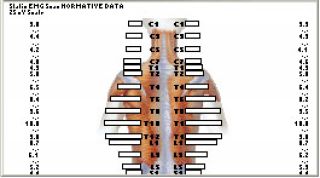
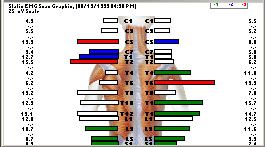
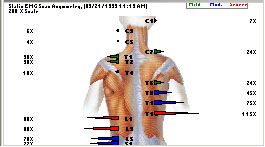
SEMG Scan Measures Electrical Current of the muscles. It Checks the Motor Nerves - controls muscles | |||||||
White bars indicate normal areas of function. Green bars indicate mild areas of abnormal function. Blue bars indicate moderate areas of abnormal function. Red bars indicate severe areas of abnormal function. Surface Electromyography (SEMG Scan). Your muscles are controlled by nerves. The SEMG measures how well the motor nerves are working by reading the amount of current found in the muscles. Subluxations, which are misalignments, disturb the function of the nerve causing an abnormal amount of electrical current flowing to your muscles. Abnormal tests are shown by colors other than white and asymmetrical bars widths. |
| ||||||
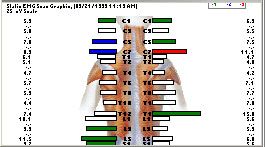
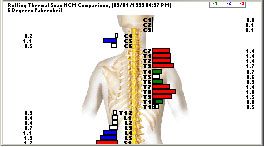
Muscle Balance Symmetry | |||||||
Muscle Balance (Symmetry). Muscle Balance is extremely important because the vertebrae in the spine depend on the muscles to move properly. If one or more of the vertebrae are out of their normal position, it disturbs nerve function. This disturbance creates muscle imbalance caused by an abnormal amount of electrical current in the muscles on either side of the spine. As a result of this disturbance, the muscles can become weaker or stronger, tighter, or fatigued. The abnormal muscle pattern on the scan reveals an increased amount of tension/pull on one side compared to the other (similar to a Tug-of-War). The graph indicates area where the muscles are showing pulling patterns: Green indicates mild areas of abnormal symmetry. Blue indicates moderate areas of abnormal symmetry. Red indicates severe areas of abnormal symmetry. |
| ||||||
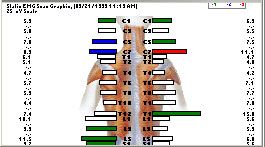
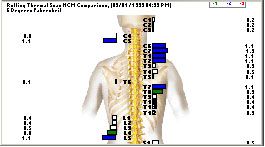
Thermal Scan - Measures Temperature Differences Autonomic Nerves - Controls Blood Vessels, Glands and Organs | |||||||
Temperature Differences (Thermal Scan) If your body temperature is 98.6 degrees, then the left and right sides of your spine should also be the same temperature. Your skin is the largest organ of the body and the blood vessels under the skin work as the body's thermostat. (They expand to release heat and contract to retain heat controlling the body's temperature.) When the communication between the Nervous System and the blood vessels is disturbed, it causes the body's thermostat to malfunction producing an imbalanced temperature reading along the spine. These blood vessels are controlled by the same part of the Central Nervous System that runs your organs and glands, known as the autonomic system. This thermal scan provides us with information to monitor the autonomic system for proper function. Loss of Motion/Flexibility (Inclinometer) A third test that Dr. Swolensky may Include in your exam is performed with a Digital Inclinometer. This test measures your spine movement as compared to a normal reading. When there is abnormal positioning of the vertebrae, it disturbs the Nervous System and causes abnormal muscle function. This causes abnormal movement in the spine. The longer the movement is restricted, the more irritation will occur causing increased degeneration. Deterioration Begins When the range of motion is restricted, your ability to move is limited and causes stress on the parts involved this begins a decaying process. This process not only affects the problem areas, but left uncorrected will negatively affect the areas above and below it (i.e. domino effect). This process is similar to your vehicle's front end when out of alignment, it limits proper movement of the tires, causing uneven wear and tear on certain areas. Decline of Overall Function and Health in YOUR Body. To summarize, your body can be malfunctioning for months, even years, before you experience any symptoms. Since symptoms are always the last to show and first to go, it is important to monitor the function of your Nervous System which is why your chiropractor utilizes the Insight Millennium. This technology provides vital information for Dr. Swolensky, who as a chiropractor is the only health care specialist trained and licensed in the detection and correction of subluxations. As a result of this expertise, the highest level of health possible may be within your reach. |
| ||||||